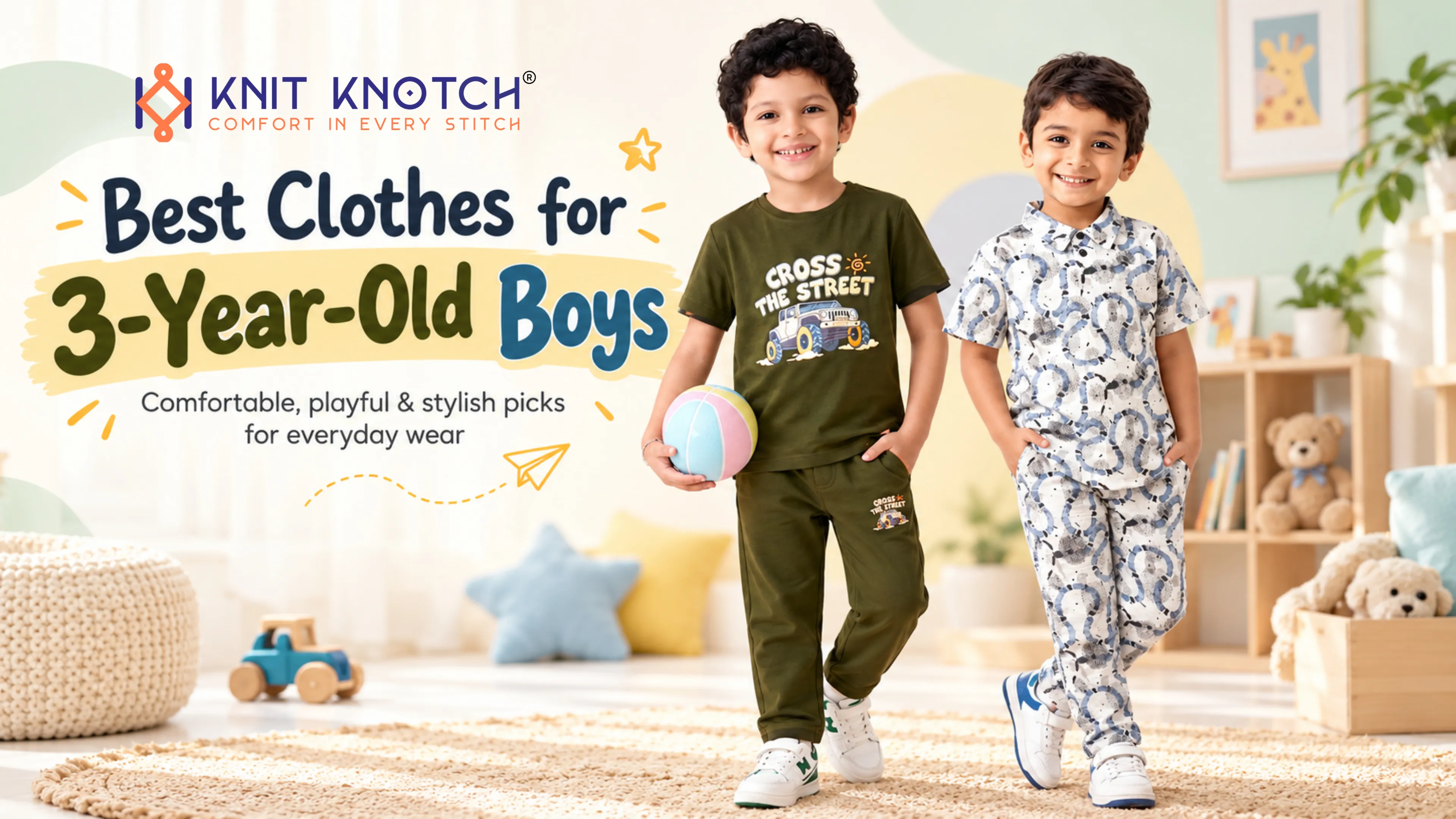
Best Clothes for 3-Year-Old Boys
A practical buying guide for dressing a 3-year-old boy covering the best outfit types (co-ord sets, joggers, shorts, ethnic wear, sleepwear), why cotton matters, how to size correctly, a full wardrobe checklist with quantities, and what to avoid.
Best Clothes for 3-Year-Old Boys
Three-year-old boys run hard, fall often, spill everything, and have strong opinions about getting dressed. The clothes that work are the ones that survive all four. Here is what to buy and what to skip.
01 What matters most at age three
Before choosing specific outfits, it helps to know what a 3-year-old boy needs from his clothes. He is learning to dress himself, going through toilet training, running and climbing for hours, and growing out of sizes every three to four months. The clothes that actually get worn share these traits:
Pull-on design: Elastic waists, wide neck openings, no buttons or buckles. If he needs help putting it on, he will fight wearing it.
Softness: Toddler skin reacts fast to rough seams, scratchy labels, and stiff fabric. Cotton is the non-negotiable baseline.
Durability: At this age, every outfit gets washed after a single wear. It needs to hold its colour, shape, and softness through dozens of wash cycles.
Freedom of movement: Tight fits, stiff denim, and structured tailoring restrict a toddler and get rejected. Loose, stretchy, and breathable is what works.
02 Co-ord sets: the daily uniform
A matching top-and-bottom co-ord set is the single most practical outfit for a 3-year-old boy. One purchase gives you a complete look with zero morning decision-making. The top and bottom are cut from the same fabric and print, so everything matches without effort.
Look for co-ord sets in 100% cotton or a 95%+ cotton blend with a small amount of elastane for stretch. The top should slip on easily over the head, and the bottom should have a fully elasticated waist with no drawstring that could catch or tighten.
KnitKnotch's boys stylish co-ord set is designed for exactly this age: soft cotton, elastic waist, relaxed fit, and prints that appeal to toddlers without looking juvenile. Each piece also pairs with other items in the wardrobe, turning one set into three or four outfit options.
A 3-year-old who can dress himself is a 3-year-old who is willing to get dressed. Co-ord sets with pull-on tops and elastic-waist bottoms are the easiest outfit type for toddlers to handle independently. That small bit of autonomy avoids the daily dressing battle. For a detailed breakdown of choosing the right set, see our co-ord set buying guide.
03 Tee and jogger combos
After co-ord sets, the tee-and-jogger combo is the most versatile option. Stock three or four solid-colour cotton tees and two or three pairs of printed joggers, and you have enough mix-and-match combinations for a full week without repeating.
Joggers work especially well for 3-year-old boys because the elastic waist and cuffed ankle stay put during running, climbing, and rough play. They're also easy to pull up and down during toilet trips, which matters at this age.
For a ready-made combination, the boys printed co-ord set pairs a graphic tee with matching track pants in soft cotton, giving you both pieces in one purchase while the separates still work on their own with other wardrobe items.
04 Shorts and tees for summer
In Indian summers, full-length joggers can get too warm for outdoor play. Cotton shorts with a simple tee are the hot-weather staple. Look for shorts with an elastic waist (no zip fly at this age) and a length that hits just above the knee for unrestricted movement.
Keep two or three pairs of cotton shorts in the rotation alongside the joggers. They also work well for indoor play at home and for layering under a kurta during warm-weather festivals.
05 Ethnic wear for festivals and family events
Kurta-pyjama sets, dhoti-kurta sets, and simple Nehru-jacket combos cover festivals, weddings, and family functions. The rule at age three is simple: keep the construction easy and the fabric comfortable.
Cotton or cotton-silk blends over pure silk or heavy brocade. The child will wear it for hours in warm, crowded settings.
Elastic-waist pyjamas or dhotis. A tied waistband comes undone within minutes on a toddler. Elastic stays put.
Light embroidery or block print gives the festive look without the weight and scratchiness of heavy zari or sequin work.
One or two ethnic sets is enough. Boys grow out of them before the next festival season, so heavy investment here has poor returns.
"The right outfit for a 3-year-old at a wedding is the one he forgets he is wearing. If he is tugging at it, refusing to sit, or asking to change, the outfit lost, no matter how good it looked in the photo."
06 Sleepwear
Night suits for a 3-year-old boy should be the softest items in the wardrobe. A simple cotton tee with loose cotton pants or shorts is all that is needed. Look for 100% cotton with a GSM of 140-160: heavy enough to feel substantial but light enough to breathe through the night.
Skip synthetic sleepwear entirely. Polyester traps body heat overnight, leading to sweaty, broken sleep. Avoid tight elastic at wrists and ankles as well; it leaves pressure marks on toddler skin and disrupts comfort.
Three to four sets, washed frequently, covers the week.
07 Fabric guide: what works, what doesn't
At three, a boy's skin is still developing its protective barriers. It reacts faster than adult skin to rough textures, chemical finishes, and trapped moisture. Cotton is the safest everyday fabric because it breathes, absorbs sweat, softens with washing, and rarely causes irritation.
For the best comfort, look for combed cotton (smoother because shorter fibres have been removed) or organic cotton if your child has sensitive or eczema-prone skin. Our cloth material guide compares every common kids' fabric on softness, breathability, and durability.
If the fabric composition label lists polyester above 15%, the outfit will trap heat during active play and cause discomfort. A 3-year-old can't articulate that the fabric is the problem. He will simply refuse to wear the outfit or become irritable. Our cotton vs synthetic comparison breaks down the differences in detail.
08 Getting the size right
Kids' sizing in India is inconsistent across brands. A "3-4 years" label on one brand may fit completely differently on another. The only reliable method is measuring your child and checking the brand's size chart.
Three measurements matter: chest circumference (around the fullest part), waist, and height. If your son falls between two sizes, size up. At three, boys grow quickly, and a slightly roomier fit lasts an extra month or two without being uncomfortable.
Elastic waists on bottoms make sizing more forgiving. For tops, check that the shoulder seam sits on the shoulder, not halfway down the arm.
09 The complete wardrobe: what you need
| Category | How many | Best type | Fabric |
|---|---|---|---|
| Everyday wear | 8-10 sets | Co-ord sets, tee + jogger combos | 100% cotton |
| Summer play | 2-3 sets | Cotton shorts + tees | 100% cotton |
| Going out | 2-3 pieces | Collared tees, smart co-ords | Cotton or cotton-linen |
| Festivals | 1-2 sets | Kurta-pyjama, dhoti-kurta | Cotton-silk blend |
| Sleepwear | 3-4 sets | Soft tee + loose pants | 100% cotton, 140-160 GSM |
| Winter layers | 2-3 pieces | Hoodies, zip-up jackets | Cotton-fleece or brushed cotton |
That is roughly 18-24 pieces total. It covers a full week with enough rotation for laundry delays, seasonal changes, and the inevitable growth spurt. For rainy season specifics, our monsoon outfit guide covers what to pick when nothing dries fast.
10 What to skip at this age
Not everything marketed for toddler boys is practical. A few categories are better avoided:
Jeans: Stiff, hot, and difficult for a toddler to pull on or off independently. Cotton joggers and shorts do the same job with far better comfort.
Dungarees with buckles: They look charming but make toilet trips slow and frustrating. At three, speed matters.
Button-down shirts: Fine buttons are beyond a 3-year-old's motor skills. He will need help every time, and that slows the morning routine.
Heavy graphic prints: Thick plastisol or rubber prints on tees crack after a few washes, feel stiff against skin, and don't breathe. Light digital prints or screen prints on cotton hold up better.
Synthetic everything: Polyester and nylon trap heat and moisture. At three, the discomfort shows up as restlessness, rashes, and outright refusal to wear the outfit again.
11 Buying checklist
Before you add to cart
- Fabric label: Read the actual composition. 95%+ cotton for everyday wear. Product titles say "cotton feel" when the fabric is not cotton.
- Neck opening: Wide enough for a toddler to pull over his head without a struggle.
- Waistband: Fully elasticated, snug but not tight, no drawstrings or hook closures.
- Seams: Turn the outfit inside out. Overlocked or flat-felled seams last. Raw edges fray within weeks.
- Size chart: Measure your child. Do not trust the age label across different brands.
- Independence test: Can he put it on and take it off alone? If not, he will resist wearing it.
- Three-wash test: After three washes, check for colour bleeding, pilling, and shape loss. That predicts the next thirty washes.
- Cost per wear: A durable Rs 450 set worn 50 times costs less per wear than a flimsy Rs 150 set worn 5 times.
For a deeper look at evaluating garment quality beyond what the label tells you, our dress quality guide covers GSM, stitching standards, and what to inspect before buying. India's Bureau of Indian Standards (BIS) sets the textile labelling rules that make fabric composition legally visible on every garment sold in the country.
Frequently asked questions
Comfortable cotton sets for toddler boys
KnitKnotch makes soft cotton co-ord sets, printed tee combos, and everyday wear for 3-year-old boys. Breathable fabrics, elastic waists, playful prints, and most of it under Rs 500.
Shop Boys Co-ord Sets