
Best Clothes for Kids in Rainy Season, Fabrics That Survive It
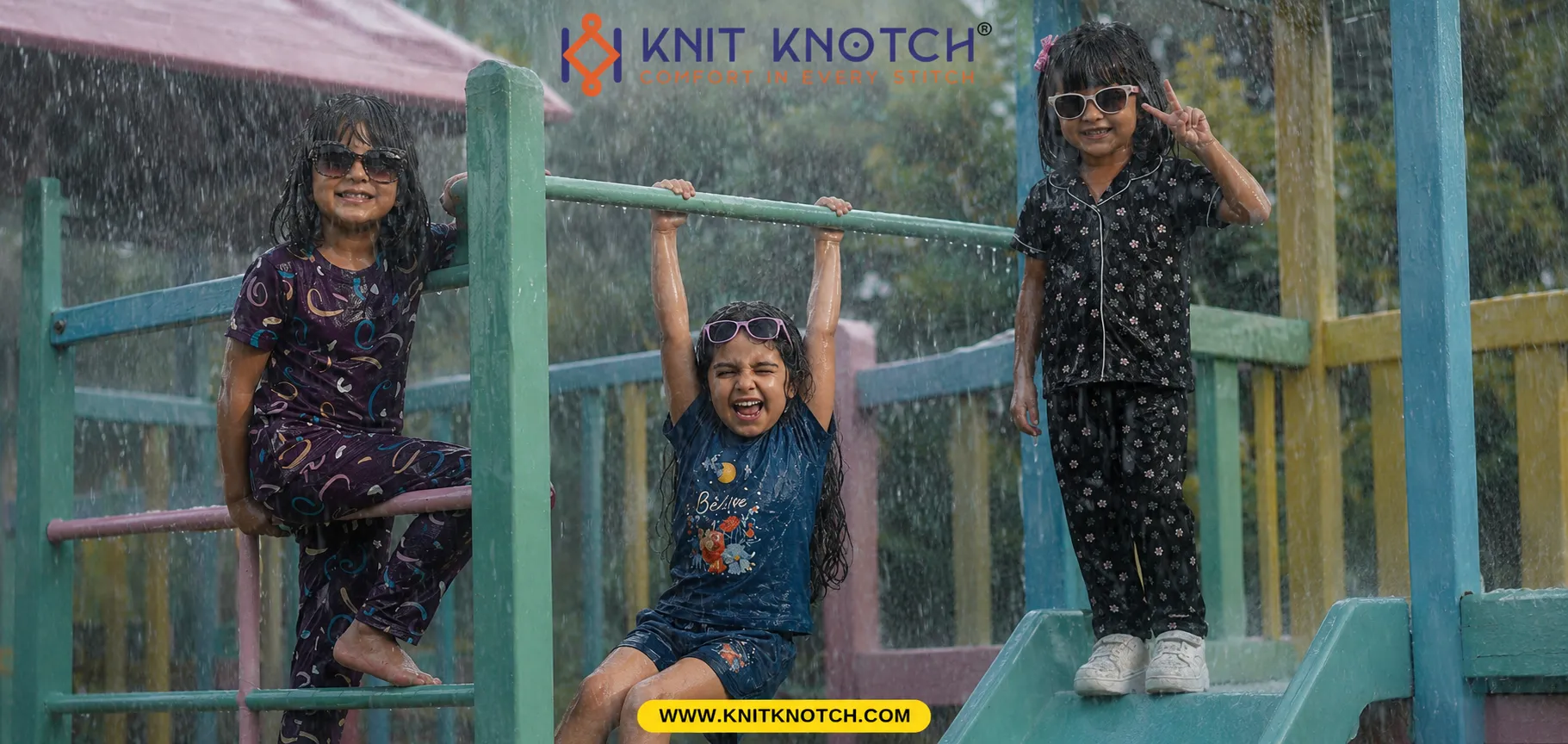
Looking for the best clothes for kids in rainy season India? This guide covers the right fabrics, what to avoid, and practical monsoon wardrobe tips for toddlers to 12-year-olds — all under one roof.
Best Clothes for Kids
in Rainy Season —
Fabrics That Survive It
Wet school bags, muddy shoes, afternoon downpours, and a kid who somehow got soaked from the knees up despite an umbrella. Indian monsoon dressing for children is a specific problem. Here's how to solve it.
June through September in India is a different problem than summer. It's not just heat — it's heat plus humidity plus the near-certainty that your child will come home damp at least twice a week. The fabric choices that worked in April stop working in July. Thick cotton takes forever to dry. Synthetic fabrics feel like a plastic bag in 85% humidity. Jeans are basically unwearable.
Most parents figure this out through trial and error — usually after pulling a damp, slightly sour-smelling school uniform out of a bag on a Wednesday morning. This guide skips that part.
"Monsoon dressing for kids comes down to one question: if this gets wet at 8am, will it be dry and comfortable by noon? Most parents don't ask it until after they've bought the wrong thing."
The Fabric Breakdown — What Works and What Doesn't
Quick Reference — Do and Don't This Monsoon
- Light cotton shorts sets and co-ord sets
- Cotton-blend half-sleeve tees with shorts
- Dark colours — navy, olive, black, deep teal
- Elasticated waists (easy to remove wet bottoms quickly)
- Flip flops or waterproof sandals over closed shoes
- A spare set in the school bag on heavy rain days
- Jeans and denim shorts — takes all day to dry
- Heavy hoodies and sweatshirts
- White or very light colours on school days
- Embroidered or heavily embellished garments
- Full-sleeve synthetic tops worn all day indoors
- Canvas shoes without waterproofing
Age-by-Age — What Actually Works
The fabric logic is the same across ages, but what you're dressing for changes a lot between a 1-year-old and a 10-year-old.
| Age group | Best clothing type | Shorts or full length? | Spare set needed? |
|---|---|---|---|
| Toddlers (1–3 yrs) | Light cotton co-ord sets, elasticated waist essential | Either — depends on AC exposure | Always |
| Preschool (3–5 yrs) | Cotton shorts sets, short-sleeve tee + loose shorts | Shorts preferred | Yes — they will sit in puddles |
| Primary school (6–10 yrs) | Shorts or capri co-ords, cotton blend for school travel | Capri for AC classrooms | One spare on rainy days |
| Older kids (10–12 yrs) | Cotton joggers, light cotton tees — relaxed fits | Full length if AC-heavy school | Usually fine without |
"The spare-set-in-the-bag trick is the most underused monsoon parenting hack. A dry cotton co-ord set costs Rs400. The alternative is your child sitting in damp clothes through maths class."
The AC Problem Nobody Mentions
Indian monsoon has a specific clothing challenge that doesn't exist in most other countries: the combination of outdoor humidity and aggressive indoor air conditioning. Your child goes from 34°C and 85% humidity outside to a 22°C air-conditioned classroom. Then back out. Then back in.
Light cotton handles this reasonably well because it breathes in the heat and provides a light layer in the cold. Pure synthetic fabrics don't — they feel clammy in the humidity and cold in the AC. If your child's school or daycare runs cold AC, a thin cotton half-jacket or a light full-sleeve layer over a shorts set is more useful than anything else in the monsoon wardrobe.
Colour Choices — More Practical Than You'd Think
This isn't about aesthetics. Wet pavement, muddy school bags, and kids who don't notice they're dragging a sleeve through a puddle make dark colours the practical monsoon choice. Navy, olive, charcoal, and deep teal hide wet-weather grime far better than white, yellow, or light pink.
That said — a full monsoon wardrobe in dark colours is depressing for a 4-year-old. A bright orange or cobalt blue co-ord set on an indoor day where there's no school run is completely fine, and frankly cheers everyone up in a week of grey skies.
5 practical monsoon wardrobe tips for Indian parents
- Buy 3–4 rotation sets: In monsoon, clothes dry slower. Having three or four light cotton sets in rotation means you're never scrambling for something dry on a Tuesday morning.
- Zip-lock a dry spare in the school bag: One sealed set costs nothing to pack. On the day your child gets soaked on the way to school, you'll be glad it's there.
- Wash cold, hang indoors with a fan: Hot water wash makes cotton shrink faster. Cold wash in a machine, then hang near a ceiling fan — most light cotton dries in 4–5 hours even in monsoon humidity.
- Avoid white socks entirely: Wet red mud from Indian pavements and white cotton socks is a combination that no amount of scrubbing fully fixes. Switch to dark socks or no-show socks June through September.
- Check elastics before the season: Waistband elastics on last year's pants weaken over time. A loose waist on a damp pair of shorts is a specific kind of inconvenient. Replace the ones that don't hold before July.
What KnitKnotch Has for Monsoon
Our co-ord sets and shorts sets use soft cotton that sits in the 150–180 GSM range — light enough to dry in a few hours, dense enough to feel like actual clothing. The waistbands are elasticated and cased, not the flat-sewn kind that rolls and loosens after a few washes. Most of the range stays under Rs500.
For monsoon specifically, the boys' Bermuda shorts sets and girls' short sets in dark prints are the practical picks — the darker base colours hide splashes and the cotton weight is right for both humid outdoor and AC indoor conditions.